SWIRLED AND LAYERED ICE CREAMS
Inspired by our favourite cheesecake filling recipe.
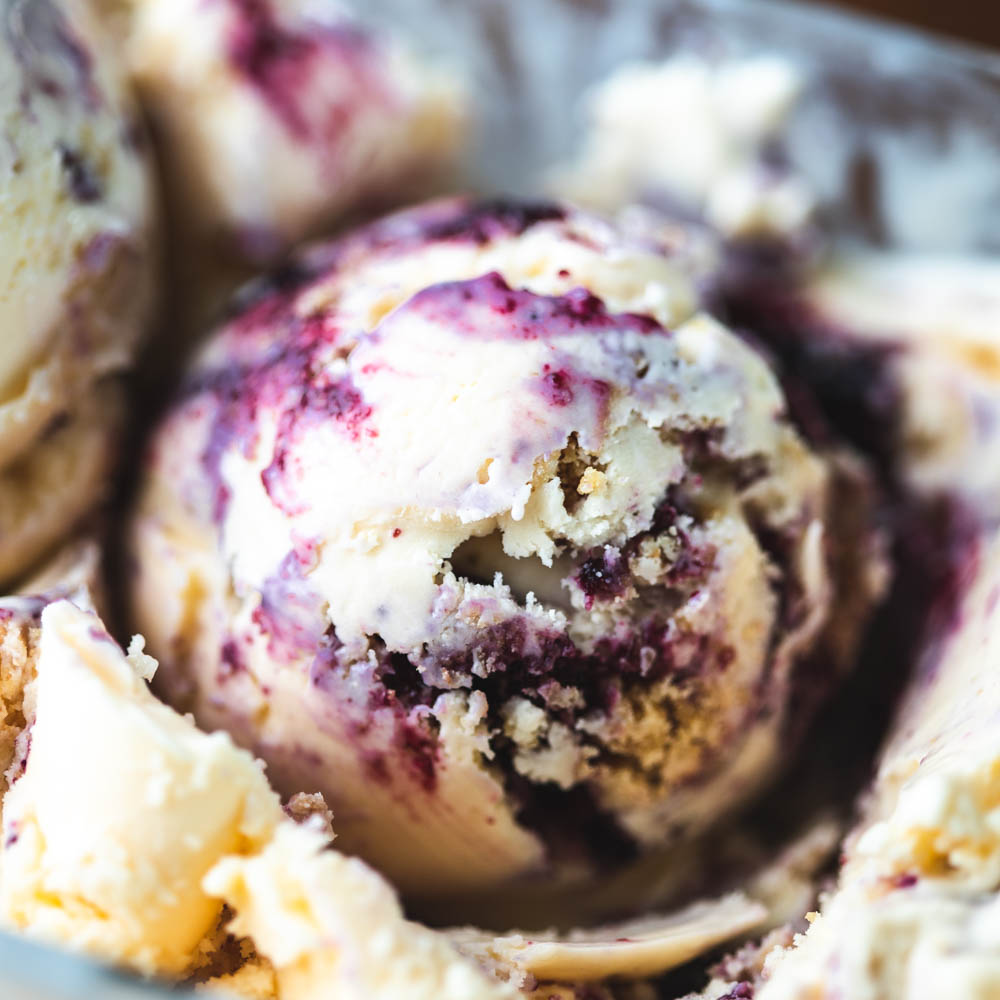
The Cheesecake Filling Ice Cream is inspired by one of Yotam Ottolenghi’s and Helen Goh’s cheesecake recipes, as written in their brilliant book “Sweet”. It is the best cheesecake recipe we have ever made and is much honoured by everyone. It is creamy, with the right amount of tanginess, a touch of lemon essence, and a luscious mouthfeel.
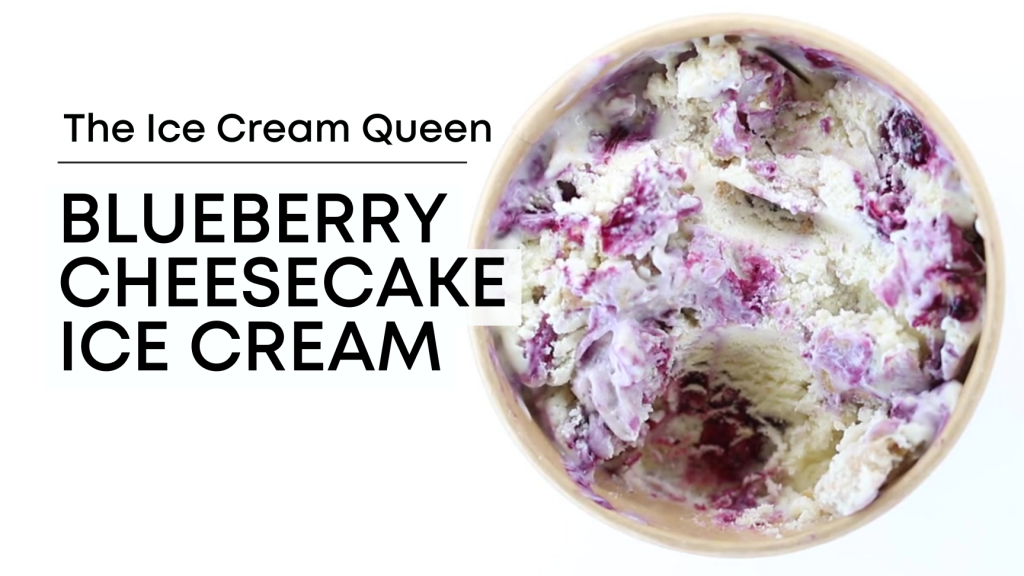
The ice cream version you will find here has all the above and yet it churns and fluffs up beautifully, creating the most creamy and utterly tasty cheesecake ice cream.
The blueberry sauce is made in a breeze, but you may as well replace it with blueberry jam; although I do recommend making it on your own to balance the sweetness and let the flavours shine.
For the cheesecake crust effect we make crunchy biscuity crust bites which are scattered into the ice cream, getting in the way of blueberry swirls and adding the unmistakable flavour and crunchiness of the original crust.
or see:
Do not reduce or replace anything; everything is there for a reason.

• Sugar: you can use regular sugar (white granulated sugar) or a raw cane sugar such as Demerara or Turbinado, which enhances the chocolate’s flavour.
Do not use any other sugar or sweetener, natural or artificial, liquid or powder, like honey, stevia, golden syrup, table sweeteners, confectioner’s sugar, etc.
• Milk: use whole milk, with around 3,5% fat. Do not substitute with skimmed milk (lower fat) or non-dairy milk. You need the fat, milk proteins and lactose that whole milk contains for this ice cream recipe.
• Heavy cream: For this recipe, you can use heavy cream with 35% and up to 36% fat content. It is also OK to use heavy cream suitable for whipping or ultra-pasteurised cream, if it has the right fat content (35-36% fat). Do not use low-fat or non-dairy cream, the ice cream will be icy.
• Egg yolks: we use eggs in the range of 65 – 75 gr; 2.3 – 2.65 oz (this is the weight of a whole egg, in its shell) , but it is ok to use larger or smaller ones. It’s easier to separate the egg yolks from the whites when the eggs are cold.
• Cream cheese: We use the original Philadelphia cream cheese, which is our favourite and also the easiest-to-find cream cheese brand. Only use the full-fat version for a perfect ice cream mouthfeel and flavour.
• White chocolate: use real white chocolate which is made with cocoa butter; avoid the cheap fake staff which contains oil, like palm oil. If in doubt check the ingredients on the packaging: real white chocolate contains sugar, milk powder, cocoa butter and a couple more ingredients like lecithin, and vanilla.
• Flavourings:
Vanilla Extract: (not pictured) we do not use vanilla extract, but if you want, you can use it.
Lemon strips: peeled from a fresh lemon with a vegetable peeler or a sharp knife
• Blueberries: use blueberries fresh or frozen. Small-sized blueberries are more flavourful, as most of the blueberries’ flavour is on their skin. That said, we have tested this recipe with all kinds of blueberries: small-sized, seasonal blueberries; large-sized, imported blueberries; and frozen blueberries; all blueberry ice creams came out perfect, so use whichever you like.
When making ice cream prefer to weigh all the ingredients by weight. We also recommend weighing the liquids directly into the bowl/pan as you proceed with the recipe instead of transferring them from one bowl to another because this transfer causes a small -but unwanted- loss of quantity.
If you do not have a kitchen scale, follow these guidelines:
• 1 cup (US) = 237 ml | 1 Tbs. = 15 ml
• white chocolate/couverture: measuring chocolate by volume is impossible because measurements vary depending on how finely chopped the chocolate is. What you can do instead is to calculate the number of pieces you need based on the weight of the chocolate bar as written on the packaging. Alternatively, you can measure the white chocolate melted: 200 g; 7 oz of melted chocolate is 2/3 cup (160 ml).
• sugar: measuring sugar in tablespoons is more accurate than measuring it in cups. Use a 15 ml measuring tablespoon (not a regular one); this is 13 gr of sugar. To measure correctly, each time you scoop the sugar, level it with the flat side of a knife.
• milk and cream: thoroughly scrape with a rubber spatula any residues left on the sides and bottom of the cup every time you measure something and empty it.
Note that the quantities in each measuring system (grams, ounces, and cups) in our recipes may not be accurate conversions, while any deviations you may notice do not affect the outcome.
This recipe makes a 1.2 litre/quart ice cream mixture (before churning), perfect for ice cream makers with a capacity of 1.5 and up to 2 litres/quarts (like Cuisinart ice cream makers).
If you need to scale the ice cream mixture up or down, use this ratio of the ingredients (in weight only):
white chocolate 6.8% / egg yolks 6.8% / heavy cream 10.2% / milk 27.1 % / sugar 12.3% / cream cheese 36% / vanilla extract 0.8%
in desired total weight of ice cream mixture,
and roughly 2 lemons strip, 3-cm long each
For example, if you want to make 1000 g (approx. 1 litre) of ice cream mixture, you need:
• 1000 g x 6.8% = 68 g white chocolate
• 1000 g x 6.8% = 68 g egg yolks
• 1000 g x 10.2% = 102 g heavy cream
• 1000 g x 27.1% = 271 g whole milk
• 1000 g x 12.3% = 123 g sugar
• 1000 g x 36% = 360 g cream cheese
• 1000 g x 0.8% = 8 g vanilla extract
and 2 lemon strips, 3-cm long each
A flexible rubber spatula is good for:
-wiping the bottom of the saucepan when you cook dairy on the stovetop.
-scraping residues from bowls, saucepans etc.
If you do not have one, we strongly encourage you to buy one, preferably a flexible one.
The ice cream mixture needs to cool completely before churning, so prepare it in advance (approx. 8 hours before) to give it time to chill in the refrigerator.
If your ice cream maker has a removable freezer bowl, put it in the freezer for the whole time indicated by the manufacturer before churning, usually 24 hours.
Place a rubber spatula and a whisk on a plate next to the stovetop to have them ready to use interchangeably.
Prepare the egg yolks: put the egg yolks (4 egg yolks) in a medium heatproof bowl, and whisk them lightly to break them down. Set the bowl next to the stovetop.
Pour the cold heavy cream (120 g; 4.2 oz) into a jug and set it nearby. If you do not proceed with the recipe immediately, put it in the refrigerator to keep it cold.
Warm the milk and the sugar: place the milk (320 g; 11.3 oz) and the sugar (145 g; 5.1 oz) in a medium saucepan. Warm over medium heat, often stirring, until the sugar dissolves.
Pour the warm milk into the egg yolks: when all the sugar dissolves and the milk is hot and steamy, remove it from the heat and slowly ladle the warm milk over the egg yolks with one hand while whisking them vigorously with the other hand to temper them.
Cook until thickened: pour the tempered yolks & milk back into the saucepan and over medium-high heat. Cook, constantly stirring with a rubber spatula and scraping the bottom of the saucepan to prevent the custard from scalding. Maintain a medium temperature, do not let it come to a boil.
Remove from the heat when the custard starts to thicken (82ºC / 179 ºF / when it thickens to coat the back of a spoon / when you tilt the saucepan, a layer of thickened custard appears to form on the bottom).
Pour the cold heavy cream into the saucepan with the custard and immediately stir to combine (this lowers the temperature and stops the cooking process of the custard).
Add the chopped white chocolate (80 g; 2.8 oz) and whisk to melt.
Place the cream cheese (425 g; 15 oz) into a large heatproof bowl and stir to soften.
Add the custard into the cream cheese a little at a time, stirring until smooth before each addition. To do so, begin by stirring the custard into the cream cheese using the spatula or a wooden spoon; when the mixture loosens, switch to a whisk and continue whisking until smooth.
Blend for one minute with an immersion blender to ensure a smooth texture, pausing midway to scrape the bottom and sides of the bowl.
Add the lemon strips.
Cool the mixture with an ice bath: Transfer the ice cream mixture to a clean, heatproof bowl. Nest this bowl inside a larger one and fill the empty space around it with ice cubes and cold water to create an ice bath. A standard ice cube tray—about 200 g / 7 oz of ice—is enough to cool down the mixture sufficiently.
Let the mixture cool in the ice bath for about 30 minutes, stirring occasionally to help it cool evenly.
Chill in the fridge overnight: Once the mixture is no longer warm, cover the bowl and refrigerate for at least 8 hours or up to 3 days. The base should be fridge-cold before churning.
Put the blueberries and the sugar in a small saucepan and warm over medium heat, often stirring, until the sugar dissolves.
Increase the heat to medium-high and cook, constantly stirring with a rubber spatula, just until it sizzles when you scrape the bottom of the saucepan and is a loose jam-like consistency.
Remove from the heat and transfer to a bowl to cool.
Cover and put in the fridge overnight until cold. Store for up to one week in the fridge.
Place the biscuits in a food processor and blitz to form fine crumbs.
Add the melted butter. Stir with a spoon to combine; the mixture should be the consistency of wet sand; if it is too dry, add one teaspoon of neutral-flavoured oil, such as canola oil.
Transfer to a cutting board lined with parchment paper and press with your hands into a flat disk of 0.5 cm / 0.2″ thickness.
Cover and put in the fridge for 3-4 hours to firm up, then cut with a sharp knife into granola-sized bites.
Store in an airtight container in the refrigerator for up to one week.
Check if the ice cream mixture is cold before churning it: below 12ºC / 54ºF / it feels fridge-cold when you place your (clean) finger into it.
Prepare the ice cream maker according to the manufacturer’s instructions.
Remove the lemon strips.
Add the vanilla extract (2 teaspoons), if using.
Blend before churning: If the mixture has been chilling overnight in the fridge, give it a thorough stir, scraping the bottom and sides of the bowl.
Then, give it a quick blitz with an immersion blender to re-homogenise the mixture.
This step improves consistency and ensures a smooth, even texture.
Churn: With the machine running, pour the mixture into the canister.
Let it churn until the texture becomes creamy and fluffed up.
Depending on your ice cream maker, this may take 30 to 70 minutes.
This ice cream mixture expands and becomes airy as it churns. You’ll know it’s ready when it looks smooth, creamy, and slightly wavy—similar to soft-serve ice cream. Churning time varies depending on your machine and can take anywhere from 30 to 70 minutes.
To check the texture, lift a spoonful. It should be thick enough to stay on the spoon, but still soft. If it looks too thin or starts melting immediately, it needs more time.
If you’re unsure, let it churn for 10 more minutes. Keep in mind that it won’t look like store-bought ice cream at this point—it will still be soft. It only becomes firm and scoopable after a few hours in the freezer.
Stop the machine once the mixture is thick and creamy. If you continue churning beyond that point, the mixture can start losing the air it has built up and may seize, resulting in a dense, heavy texture.
One important note: some ice cream makers are programmed to stop automatically after a fixed time, but that doesn’t always mean the ice cream is ready. If your machine stops and the mixture still looks too soft, simply restart it and continue churning until the texture improves.
Put in the freezer to set: before serving the ice cream or moving it to a container for storing, you have to put it in the freezer to set. To do so, turn off the ice cream maker and:
· remove the removable freezer bowl (still filled with the ice cream) from the ice cream machine
· remove the paddle, scraping any ice cream attached to it back into the ice cream bowl
· cover the ice cream bowl and place it in the freezer
Setting time depends on many factors; see notes below for indicative times.
Serve or store: when it sets, you can serve it directly from the removable freezer bowl or transfer it to an airtight container for longer storage.
The setting time depends on the type of ice cream maker you’re using. Here are the general guidelines:
3–5 hours for machines with removable freezer bowls (these bowls must be pre-frozen before churning)
Under 1 hour for machines with built-in compressors and aluminum bowls
⚠️ Important: Ice cream in aluminum bowls sets quickly. Do not leave it for too long—once fully frozen, it can become extremely hard and difficult to remove without risking scratches to the bowl. Always monitor it closely.
To check if the ice cream is ready, aim for an internal temperature of –11°C (12°F). If you don’t have a thermometer, use this simple test:
Insert a round-tip knife all the way to the bottom of the ice cream:
✔ If it goes in smoothly but meets gentle resistance, it’s ready
✖ If it feels hard on top but soft underneath, it needs more time
✖ If it’s too firm to insert the knife, it’s over-frozen and likely too hard to scoop
If it’s over-frozen, don’t worry—head to the next section for how to bring it back to scoopable.
If the ice cream sits in the freezer in the removable freezer bowl for too long after it has set, it can become too hard to scoop or remove.
To make it scoopable again:
Place the bowl in the refrigerator and allow the ice cream to soften gradually.
Here’s how long that may take:
4–10 hours for removable freezer bowls (pre-freeze models)
1–2 hours for aluminum bowls (from compressor ice cream makers)
Note: These times are approximate and may vary depending on your fridge and the amount of ice cream. Check the texture occasionally as it softens.
Once the ice cream is soft enough to scoop—or its internal temperature reads approximately –11°C (12°F)—you can:
✔ Transfer it to another container and store it in the freezer
✔ Or serve it directly from the bowl
Just be sure to avoid digging into an over-frozen bowl with hard utensils, especially if using a nonstick-coated or aluminum bowl.
Straight after churning, the ice cream has a soft-serve consistency and melts almost instantly on contact. At this stage, it’s too soft to serve neatly or transfer easily—it’s simply too messy to handle.
Freezing the ice cream immediately after churning allows it to set properly. This step brings it to the right texture: scoopable, stable, and easy to portion or transfer into a storage container.
It’s the final step that turns churned ice cream into finished ice cream.
Storing: Transfer the finished ice cream to a lidded container and store it in the freezer for up to one month.
Cover it well to protect it from absorbing any unwanted freezer smells.
Scooping: Like all artisanal-style ice creams, this one freezes hard over time.
To make it scoopable again, place the container in the refrigerator for 45–60 minutes, or until the internal temperature reaches about –11°C (12°F).
Once softened, it’ll scoop cleanly and serve beautifully.
When making ice cream, prefer to weigh all the ingredients, even the liquid ones. We also recommend – whenever possible – to weigh the liquid ingredients directly into the bowl/pan as you proceed with the recipe instead of transferring them from one bowl to another because this transfer causes a small -but unwanted- loss of quantity.
If you do not have a kitchen scale, follow these guidelines:
• 1 cup (US) = 237 ml | 1 tablespoon = 15 ml
• sugar: measuring sugar in tablespoons is more accurate than measuring it in cups. Use a 15 ml measuring tablespoon (not a regular one); this is 13 gr of sugar. To measure correctly, each time you scoop the sugar, level it with the flat side of a knife.
• milk and cream: thoroughly scrape with a rubber spatula any residues left on the sides and bottom of the cup every time you measure something and empty it.
Note that the quantities in each measuring system (grams, ounces, and cups) in our recipes may not always be accurate conversions, while any deviations you may notice do not affect the outcome.
A flexible rubber spatula is good for:
-wiping the bottom of the saucepan when you cook dairy on the stovetop.
-scraping residues from bowls, saucepans etc.
If you do not have one, we strongly encourage you to buy one, preferably a flexible one.
Your privacy settings
Manage Consent Preferences
Necessary
Analytics
Embedded Videos
Marketing
Facebook Advanced Matching
Facebook CAPI