

SWIRLED AND LAYERED ICE CREAMS
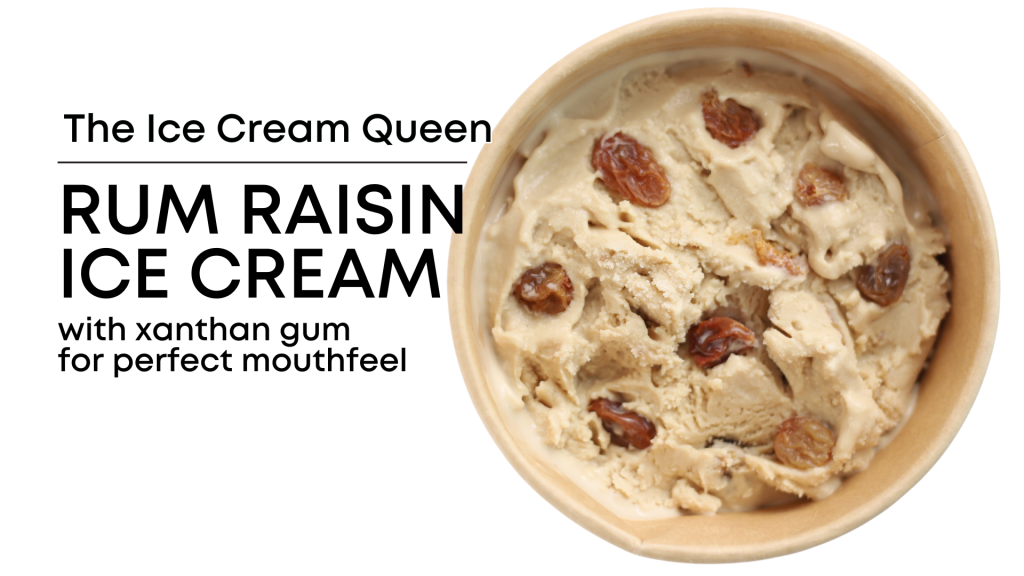
With rum & raisins, milk, heavy cream, sugar, xanthan gum, and gelatine.
Get ready for a seriously adult treat! Our Rum Raisin Ice Cream is not for the faint-hearted. We use both xanthan gum and gelatine to ensure that this ice cream takes in as much rum as possible. While gelatine may not be commonly used in ice cream, it is the secret ingredient that allows this dessert to churn to its fullest potential without being compromised by the high rum content. The raisins soak overnight in rum, becoming little pockets of flavour that burst with every bite.
And here’s a little secret to take your rum experience to another level: instead of regular sugar, we use a mix of raw cane sugars, Demerara sugar, and Dark Muscovado sugar. The tropical notes of these sugars complement the rum perfectly, enhancing its flavour without overpowering it. These sugars also give the ice cream a lovely light brown colour that is visually appealing. Check out the Notes section of the recipe for more information on these sugars. And yes, you can skip them and use regular white sugar instead; this ice cream will still be excellent without them!
When making ice cream prefer to weigh all the ingredients by weight. We also recommend, whenever possible, weighing the liquid ingredients directly into the bowl/pan as you proceed with the recipe instead of transferring them from one bowl to another because this transfer causes a small -but unwanted- loss of quantity.
Note that the quantities in each measuring system (grams, ounces, and cups) are not accurate conversions; we sometimes round them up in a way that makes sense. Small deviations do not affect the outcome.
If you do not have a kitchen scale, follow these guidelines:
• 1 cup (US) = 237 ml | 1 tablespoon = 15 ml
• sugar: measuring sugar in tablespoons is more accurate than measuring it in cups. Use a 15 ml measuring tablespoon (not a regular one); this is 13 gr of sugar. To measure correctly, each time you scoop the sugar, level it with the flat side of a knife.
• liquid ingredients: thoroughly scrape with a rubber spatula any residues left on the sides and bottom of the cup every time you measure something and empty it.
This recipe makes a 1.2 litre/quart ice cream mixture (before churning), perfect for ice cream makers with a capacity of 1.5 and up to 2 litres/quarts (like Cuisinart ice cream makers).
If you need to scale the ice cream mixture up or down, use this ratio of the ingredients (in weight only):
milk 43.4% / heavy cream 35.5% / sugar 15.6% / dark rum 5.38% / xanthan gum 0.12% / approx. 1 sheet gelatine (or 1.5 teaspoon gelatine granules) for every 30 ml rum calculated
in the desired total weight of the ice cream mixture.
For the raisins: 8.7% raisins for desired total weight of ice cream mixture and for the rum 1.2 x the raisins for soaking them
For example, if you want to make 1000 g of ice cream mixture, you need:
For the raisins:
You can adjust the quantity of the xanthan gum in the recipe to your liking, depending on the texture you want to achieve:
You can read more about it here.
Tips to Enhance the Flavour of Rum Raisin Ice Cream
To give your Rum Raisin ice cream a truly exceptional taste, consider using a combination of raw cane sugars. We recommend using 100 g of raw cane sugar Demerara and 80 g of dark Muscovado sugar. This will impart a superior flavour to your ice cream and a beautiful light brown colour. If you don’t have these types of sugar on hand, don’t worry – you can still make fantastic ice cream with regular white sugar or light brown sugar.
Before using the dark Muscovado ensure that it is soft before use. Use your fingers to break down any small lumps before using it in the recipe, to ensure that they dissolve completely in the heavy cream.
Adding a cinnamon stick to your ice cream base while it’s lukewarm is another way to enhance the flavours. The cinnamon stick will stay in the base while it’s in the fridge, balancing the flavours and creating a more well-rounded taste. Just be sure not to infuse the ice cream with cinnamon while the base is hot, as this will give it a cinnamon flavour.
A flexible rubber spatula is good for:
-wiping the bottom of the saucepan when you cook dairy on the stovetop.
-scraping residues from bowls, saucepans etc.
If you do not have one, we strongly encourage you to buy one, preferably a flexible one.
The raisins must be soaked in the rum and the ice cream mixture needs to cool completely and rest before churning, so prepare both in advance, preferably the day before you are planning to churn the ice cream.
If your ice cream maker has a removable freezer bowl, put it in the freezer for the whole time indicated by the manufacturer before churning, usually 24 hours.
Soak the raisins in the rum: put the raisins (100 g; 3.5 oz) into a small bowl and pour the rum (120 g; 4.2 oz) over them. Stir to make sure all raisins are submerged in the rum. Cover and set aside to soak for at least 12 hours; during this time the raisins will absorb the most rum possible and become plumpy; this makes the raisins extra boozy. If you prefer a mild rum flavour and booziness, substitute half the rum with sugar: put 60 g rum and 60 g sugar into a small saucepan, warm over low heat, stirring to dissolve the sugar and add the raisins while it is hot.
Soften the gelatine: put the gelatine leaves (or gelatine granules) into a shallow container and cover them with ⅓ of the cold milk (165 g; 5.8 oz; ⅔ cup). Stir. If using gelatine leaves, make sure they do not overlap; if they do, stir them around as they soften to keep them separated or else they stick to each other and do not soften.
Pour the rest of the cold milk (335 g; 11.8 oz) into the blender jug and have it ready to blend (or into a large bowl, if using an immersion blender).
Bring the sugar and the heavy cream to a boil: put the sugar (180 g; 6.3 oz) into a medium saucepan. Pour in the heavy cream (410 g; 14.5 oz). Warm over medium heat, stirring often, until the sugar fully dissolves. Increase the heat to high, stirring continuously, and as soon as the heavy cream comes to a rolling boil (when large bubbles that pop vigorously appear on the surface / 90°C / 195°F / if it starts to overflow), immediately remove it from the heat and pour it into the blender jug with the cold milk.
Turn the blender on (medium speed). Note: by blending that much boiling hot cream with that much fridge-cold milk, the blend instantly reaches approx. 48°C; 118°F; This temperature is ideal for dissolving xanthan gum efficiently.
Sprinkle in the xanthan gum: with the blender on, carefully open the cap and slowly sprinkle the xanthan gum (½ teaspoon) over the surface. Blend for 2 minutes to fully hydrate the xanthan gum; do not estimate the time, set a timer. Do not expect the blend to thicken; it will thicken as it cools.
Add the softened gelatine: stop the blender and add the gelatine and its milk; blend for one minute.
Add the rum (62 g 2.2 oz) and blend to combine.
Pour the ice cream mixture into a bowl; preferably stainless steel or heatproof glass as they chill faster.Avoid using plastic or glass bowls, as plastic may not chill the mixture well, while glass may break from the sudden temperature changes.
Cool the mixture with an ice bath: Place the bowl with the ice cream mixture inside a larger one and fill the space around it with ice cubes and cold water to create an ice bath. Make sure no water gets into the mixture. About 200 g (7 oz) of ice—roughly one standard tray—is enough to cool it down properly.
Let the mixture cool in the ice bath for about 30 minutes, stirring occasionally to help it cool evenly.
Chill completely: Once the mixture is no longer warm, remove the bowl from the ice bath, cover it and refrigerate for at least 8 hours or up to 3 days. The base should be fridge-cold before churning.
Check if the ice cream mixture is cold before churning it: 4ºC–12ºC / 39ºF-54ºF / it feels fridge-cold when you place your index finger into it.
Strain the raisins: place a fine-mesh strainer over a small bowl and add the raisins and rum. You will be left with approximately 45 g of rum. Keep the raisins in the strainer and over the bowl and put them in the freezer (or in the refrigerator if you do not have space in the freezer) to chill them.
Prepare the ice cream maker according to the manufacturer’s instructions.
Blend before churning: briefly blitz the ice cream mixture with an immersion blender, stopping once to scrape down the sides and bottom with a rubber spatula. This improves consistency and ensures a smooth, even texture.
Churn: with the machine running, pour the ice cream mixture through the canister and into the ice cream maker. Leave to churn until fluffed up and creamy; depending on your ice cream maker, this can take anywhere from 30-60 minutes.
Add the raisins: with the ice cream maker running, gradually add the strained cold raisins, a tablespoon at a time. Leave to churn for 10 more minutes until the raisins are evenly distributed.
Add more rum (optional): if the ice cream is nice and fluffy after the raisins are incorporated, for an extra strong rum flavour you can add up to 2 tablespoons more rum if you are making this during winter (or up to 1 tablespoon if the weather is hot). Taste the ice cream and if you judge you want it more rumy, gradually add a tablespoon of the chilled strained rum. Reserve the rest of the rum for another use or for spooning it over the ice cream during serving.
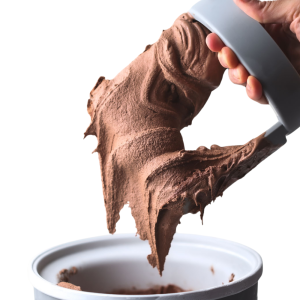
This ice cream mixture expands and becomes airy as it churns. You’ll know it’s ready when it looks smooth, creamy, and slightly wavy—similar to soft-serve ice cream. Churning time varies depending on your machine and can take anywhere from 30 to 70 minutes.
To check the texture, lift a spoonful. It should be thick enough to stay on the spoon, but still soft. If it looks too thin or starts melting immediately, it needs more time.
If you’re unsure, let it churn for 10 more minutes. Keep in mind that it won’t look like store-bought ice cream at this point—it will still be soft. It only becomes firm and scoopable after a few hours in the freezer.
Stop the machine once the mixture is thick and creamy. If you continue churning beyond that point, the mixture can start losing the air it has built up and may seize, resulting in a dense, heavy texture.
One important note: some ice cream makers are programmed to stop automatically after a fixed time, but that doesn’t always mean the ice cream is ready. If your machine stops and the mixture still looks too soft, simply restart it and continue churning until the texture improves.
Put in the freezer to set: before serving the ice cream or moving it to a container for storing, you have to put it in the freezer to set. To do so, turn off the ice cream maker and:
· remove the removable freezer bowl (still filled with the ice cream) from the ice cream machine
· remove the paddle, scraping any ice cream attached to it back into the ice cream bowl
· cover the ice cream bowl and place it in the freezer
Setting time depends on many factors; see notes below for indicative times.
Serve or store: when it sets, you can serve it directly from the removable freezer bowl or transfer it to an airtight container for longer storage.
The setting time depends on the type of ice cream maker you’re using. Here are the general guidelines:
3–5 hours for machines with removable freezer bowls (these bowls must be pre-frozen before churning)
Under 1 hour for machines with built-in compressors and aluminum bowls
⚠️ Important: Ice cream in aluminum bowls sets quickly. Do not leave it for too long—once fully frozen, it can become extremely hard and difficult to remove without risking scratches to the bowl. Always monitor it closely.
To check if the ice cream is ready, aim for an internal temperature of –11°C (12°F). If you don’t have a thermometer, use this simple test:
Insert a round-tip knife all the way to the bottom of the ice cream:
✔ If it goes in smoothly but meets gentle resistance, it’s ready
✖ If it feels hard on top but soft underneath, it needs more time
✖ If it’s too firm to insert the knife, it’s over-frozen and likely too hard to scoop
If it’s over-frozen, don’t worry—head to the next section for how to bring it back to scoopable.
If the ice cream sits in the freezer in the removable freezer bowl for too long after it has set, it can become too hard to scoop or remove.
To make it scoopable again:
Place the bowl in the refrigerator and allow the ice cream to soften gradually.
Here’s how long that may take:
4–10 hours for removable freezer bowls (pre-freeze models)
1–2 hours for aluminum bowls (from compressor ice cream makers)
Note: These times are approximate and may vary depending on your fridge and the amount of ice cream. Check the texture occasionally as it softens.
Once the ice cream is soft enough to scoop—or its internal temperature reads approximately –11°C (12°F)—you can:
✔ Transfer it to another container and store it in the freezer
✔ Or serve it directly from the bowl
Just be sure to avoid digging into an over-frozen bowl with hard utensils, especially if using a nonstick-coated or aluminum bowl.
Straight after churning, the ice cream has a soft-serve consistency and melts almost instantly on contact. At this stage, it’s too soft to serve neatly or transfer easily—it’s simply too messy to handle.
Freezing the ice cream immediately after churning allows it to set properly. This step brings it to the right texture: scoopable, stable, and easy to portion or transfer into a storage container.
It’s the final step that turns churned ice cream into finished ice cream.
Storing: Transfer the finished ice cream to a lidded container and store it in the freezer for up to one month.
Cover it well to protect it from absorbing any unwanted freezer smells.
Scooping: Like all artisanal-style ice creams, this one freezes hard over time.
To make it scoopable again, place the container in the refrigerator for 45–60 minutes, or until the internal temperature reaches about –11°C (12°F).
Once softened, it’ll scoop cleanly and serve beautifully.


4 Responses
I made this as per your wonderful instructions and WOW – it is now a firm family favorite!
So glad to heat this!😊🙏
What purpose does the gelatins serve?
Without the gelatine, the ice cream cannot take that much booze; it will not fluff up and become creamy during churning, but it will stay in a semi-liquid stage, like a slurry. And it will melt immediately during serving.