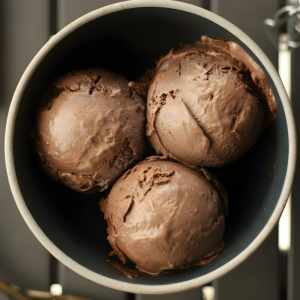
THE ITALIAN WAY TO ICE CREAM
With milk, heavy cream, sugar, and cornstarch.
This is our Italian Way to Ice Cream, because we use cornstarch to thicken the ice cream mixture, often used to make homemade Italian gelato. It is the kind of ice cream which is refreshing and cooling, with a full-bodied mouthfeel. It is also firm and resistant to melting, making it the perfect ice cream in summer when the weather is hot.
This No-Stress Caramel Ice Cream version was created because making caramel ice cream the old-fashioned way can be stressful: sugar turns to caramel, cream hits the hot pan, and suddenly there’s steam, splashing, and hardened caramel that may or may not ever melt. And unless you’re a caramel expert (who is?), you won’t know if you’ve burned it until the ice cream is finished—after you’ve already wasted time and precious ingredients.
So we created this No-Stress Caramel Ice Cream: you caramelise the sugar, pour it into a thin layer to cool and harden, then taste a piece. If you like it (and don’t eat it all), you pulverise the caramel and continue the recipe at your own pace. The caramel powder keeps for up to a month, and the flavour? Out of this world.
3 more ways to make this no-stress caramel ice cream:
PLAIN & PERFECT. This easy version uses the fewest ingredients, and relies on some extra heavy cream as the key to its rich, creamy texture. (Also known as “Philadelphia-style,” but it does not contain cream cheese.) With milk, heavy cream, sugar.
THE FRENCH-STYLE ICE CREAM. Rich and velvety, this is a custard-based ice cream; a tad bit tricky to make, but so much worth it. With milk, heavy cream, sugar, egg yolks.
LIKE A PRO. The closest you can get to store-bought ice cream with just one extra ingredient: xanthan gum. With milk, heavy cream, sugar, xanthan gum.
Do not reduce or replace anything; everything is there for a reason.

• Sugar: you can use regular sugar (white granulated sugar) or a raw cane sugar such as Demerara or Turbinado, which enhances the chocolate’s flavour.
Do not use any other sugar or sweetener, natural or artificial, liquid or powder, like honey, stevia, golden syrup, table sweeteners, confectioner’s sugar, etc.
• Milk: use whole milk, with around 3,5% fat. Do not substitute with skimmed milk (lower fat) or non-dairy milk. You need the fat, milk proteins and lactose that whole milk contains for this ice cream recipe.
• Heavy cream: For this recipe, you can use heavy cream with 35% and up to 36% fat content. It is also OK to use heavy cream suitable for whipping or ultra-pasteurised cream, if it has the right fat content (35-36% fat). Do not use low-fat or non-dairy cream, the ice cream will be icy.
• Cornstarch (A.K.A. cornflour or maize starch) in some countries is named “cornflour”, but it is not flour; it is a starch. That means that it is white in colour and powdery in texture; it looks like confectioner (powder) sugar. It is described on the label as a thickener for sauces, soups, etc.
This is a quick overview of the recipe. If you are new to ice cream making, do read the recipe before proceeding.
Cook the sugar until it is a deep brown caramel color and pour on a baking tray lined with parchment paper.

Once cooled and hardened, break the caramel into pieces and pulverise it in a food processor/blender.

Make the caramel milk: warm the milk until hot and steamy and blend, gradually adding the caramel sugar. Strain into a saucepan.
(a no-blender method is also included in the recipe.)

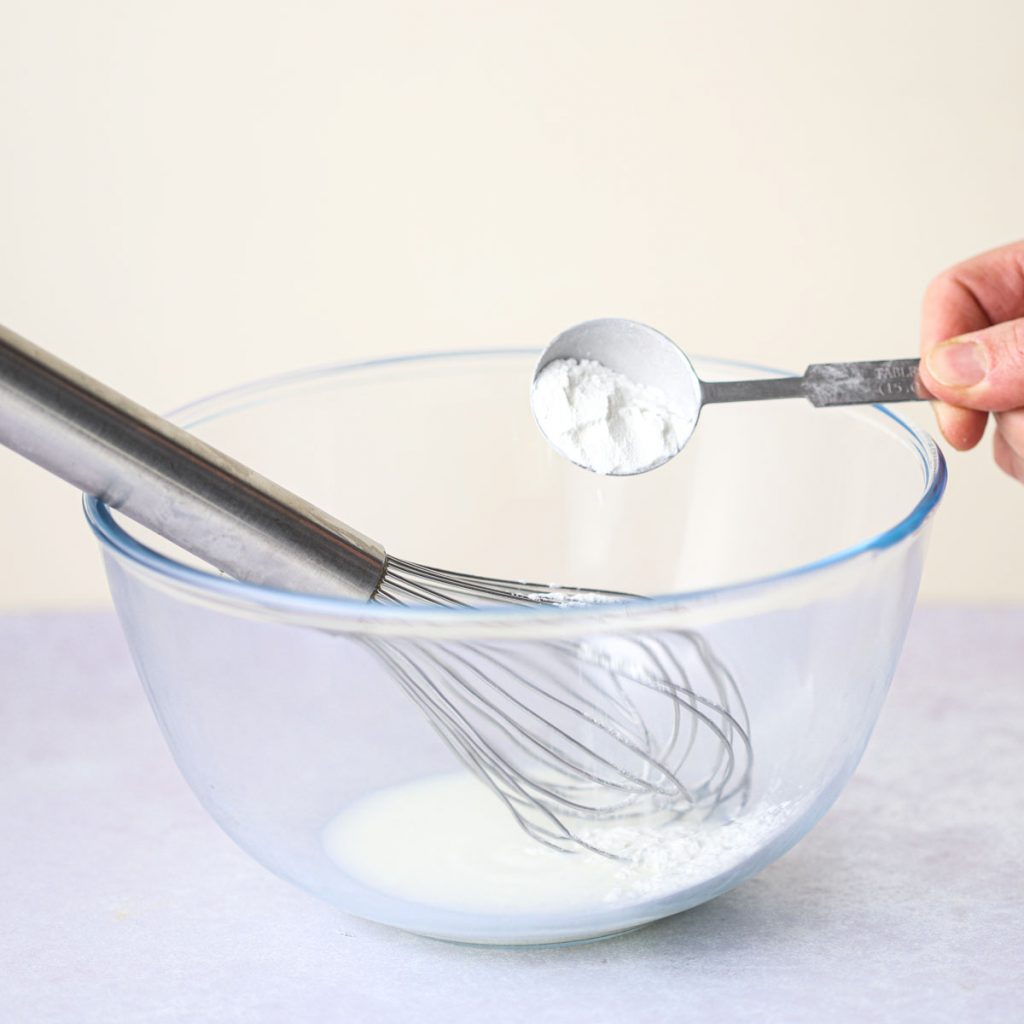
In a large heatproof bowl whisk the corn starch with 3 tablespoons of the cold milk to create a slurry.
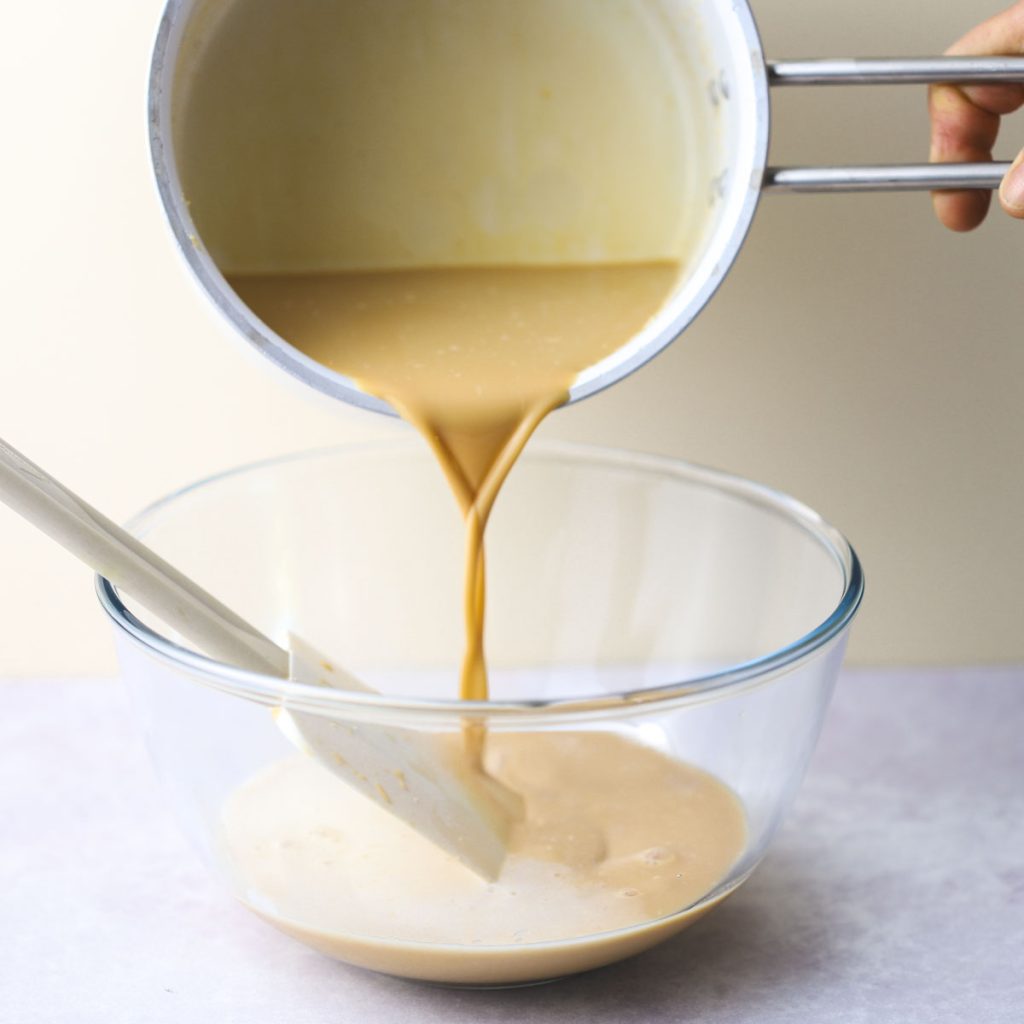
Bring to a boil the caramel milk and pour it over the corn starch slurry; stir to thicken.
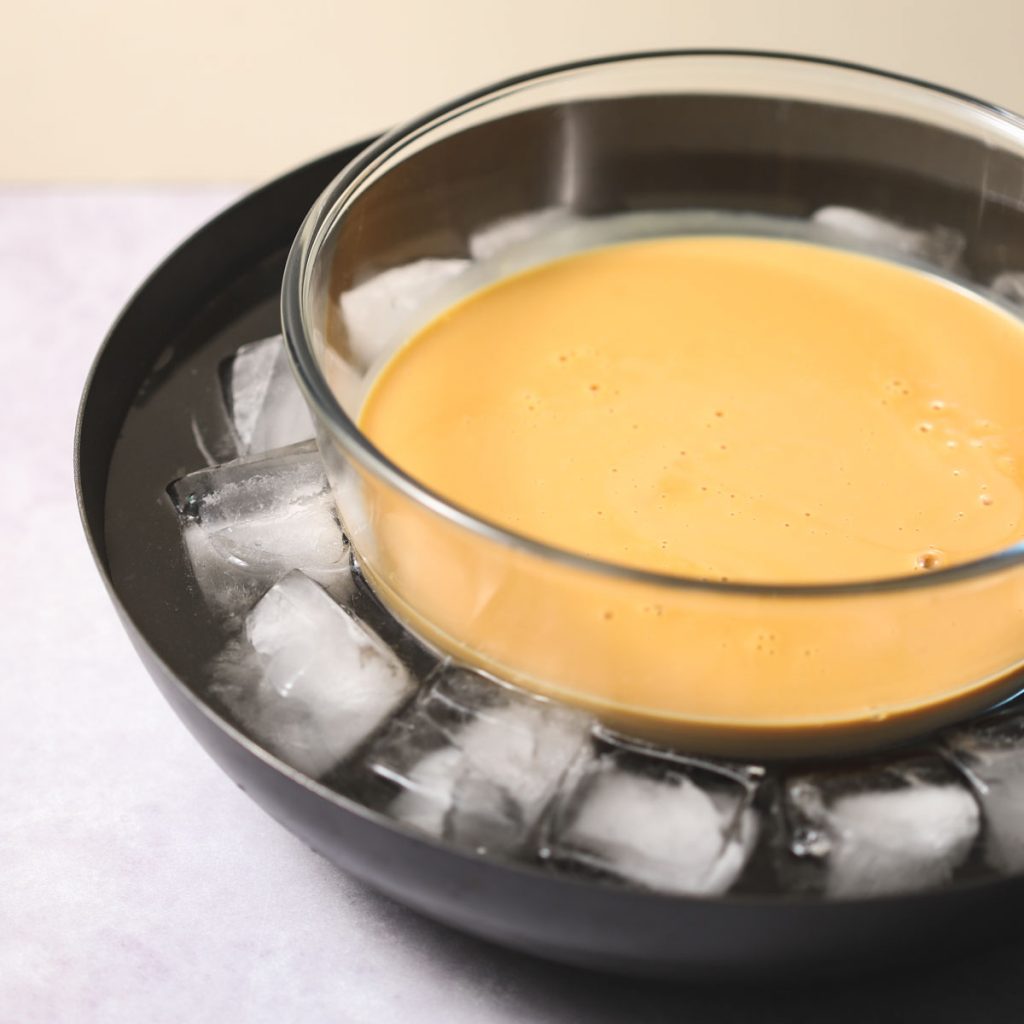
Cool it down over an ice bath.
Put the ice cream mixture in the refrigerator overnight; or until completely cold.
(a faster chilling method is also included in the recipe.)

Churn in your ice cream maker until fluffed up and creamy.

Put it in the freezer for a few hours to set.

As soon as it sets, you can either serve it from the ice cream maker bowl or transfer to a container and store it in the freezer.

When making ice cream we recommend weighing all the ingredients, even the liquid ones. Whenever possible, prefer to weigh any liquid ingredients directly into the bowl/pan as you proceed with the recipe instead of transferring them from one bowl to another because this transfer causes a small -but unwanted- loss of quantity.
If you do not have a kitchen scale, follow these guidelines:
• 1 cup (US) = 237 ml | 1 tablespoon = 15 ml
This recipe makes approx. 1.2 litre/quart ice cream mixture (before churning), perfect for ice cream makers with a capacity of 1.5 and up to 2 litres/quarts (like Cuisinart ice cream makers).
If you need to scale the ice cream mixture up or down, use this ratio of the ingredients (in weight only):
milk 55.3% / heavy cream 25.6% / caramel sugar * 17% / corn starch 2.1%
in desired total weight of ice cream mixture.
*This is the caramel sugar you need to make the ice cream mixture. To estimate the white granulated sugar for caramelising, multiply the desired caramel sugar by 1.5.
For example, if you need to make 1000 g of ice cream mixture, you need:
You can combine double cream with whole milk to make heavy cream for this recipe.
To make the 300 g (11 oz) heavy cream, you need:
To make the heavy cream, put the double cream in a medium bowl, then pour in the milk a little at a time, stirring smoothly with a rubber spatula. Avoid whisking, as it may turn into whipped cream.
The resulting heavy cream has 36% fat, perfect for this ice cream. Proceed with the recipe, just as if you had the 300 g (11 oz) heavy cream needed.
*this 90 g (3 oz) milk is extra to the 650 g milk (23 oz) asked in the recipe. So, if you use double cream, you need in total 740 g of milk (26 oz), from which:
A flexible rubber spatula is good for:
-wiping the bottom of the saucepan when you cook dairy on the stovetop.
-scraping residues from bowls, saucepans etc.
If you do not have one, we strongly encourage you to buy one, preferably a flexible one.
The ice cream mixture needs to cool completely and mature before churning, so prepare it in advance (approx. 8 hours before) to give it time to chill in the refrigerator.
If your ice cream maker has a removable freezer bowl, put it in the freezer for the whole time indicated by the manufacturer before churning, usually 24 hours.
Line a baking tray with parchment paper and place it next to the stovetop. Put two trivets beneath the baking tray to protect the counter from the heat, making sure that the tray is levelled and secure in its place.
Bring the water to a boil: in a medium, heavy-bottomed saucepan pour the water (250 g; 8.8 oz) and bring it to a boil over high heat (100° C / 212° F / it bubbles up vigorously).
Add the sugar: remove the saucepan from the heat and add the sugar (300 g; 10 oz). Stir for 1 minute and 20 seconds; do not estimate it, time it. This is the time the sugar needs to dissolve; some sugar granules left are ok.
Caramelise the sugar: return the saucepan with the syrup over medium-high heat and cook until it is a deep brown caramel colour (195° C / 383° F if you use a thermometer). Do not stir while it cooks, but as the caramel darkens, do tilt the pan gently once or twice if you notice darker spots forming, to distribute the heat evenly.
Remove the saucepan from the heat and pour the caramel over the parchment paper, scraping with the rubber spatula caramel residues from the saucepan,
Let it cool down for approximately 30-40 minutes or until it doesn’t feel warm to the touch (this is at 27° C / 80° F if you use an infrared thermometer).
Note that the caramel is very sensitive to humidity, so from now on, take care that anything it comes into contact with is completely dry. Don’t leave it exposed to the kitchen’s humidity either; as soon as it comes to room temperature, either proceed with the recipe or put it in an airtight bag.
Break the caramel into pieces with your hands (dry, please) and put the pieces in a (completely dry) blender jug/food processor. Pulse to break the caramel to as fine as possible.
A blender creates a fine powder which dissolves easily. A food processor breaks the caramel into pieces, the size of a rice grain, which just take a little longer to dissolve.
Store the caramel sugar: immediately weigh the caramel sugar (200 g; 7.1 oz; all of it if measuring in cups) you need for the ice cream into a (completely dry) airtight container and close the lid. Proceed with the recipe, or keep it for up to one month. Any leftover caramel sugar can be stored in an airtight container and used to sprinkle over the ice cream or to flavour your coffee.
Set up your blender; it should be heatproof and large enough to blend 850 ml of warm liquid. If you do not have a blender, see at the end of this step how to make the caramel milk on the stovetop.
Warm the milk: put the milk (650 g; 23 oz) in a medium saucepan and warm over medium heat, stirring often, until the milk is hot and steamy (this is at 75° C / 167° F if you have a thermometer). Do not let it boil.
Pour the warm milk into the blender. With the blender on, gradually add the caramel sugar (200 g; 7.1 oz), blending to dissolve it.
Strain the ice cream mixture over a fine-mesh sieve and back into the saucepan you used to warm the milk (no need to rinse).
If any small bits of caramel sugar are left on the sieve after straining, just put them back in the caramel milk; they will gradually dissolve. But if there are large clumps of undissolved caramel sugar left, put them into another saucepan with a splash of the caramel milk and stir over medium heat to fully melt, before adding back to the caramel milk.
In a medium saucepan, put the milk (650 g; 23 oz) and warm over medium heat, stirring often with a rubber spatula.
When it is hot and steamy, add the caramel sugar (200 g; 7 oz) one tablespoon at a time by sprinkling it over the surface of the hot milk and stirring with the spatula after each addition.
While you add the caramel sugar, tap the tablespoon on the saucepan to shake off the caramel sugar that sticks to it. When you finish adding the caramel powder, insert the spoon into the milk and leave it there to allow all residues to melt.
Stir and whisk as needed to dissolve all the caramel sugar.
Strain the ice cream mixture over a fine-mesh sieve and into a bowl. If there is undissolved caramel sugar in the sieve after straining, put it back into the saucepan along with a splash of the warm caramel milk and stir over medium heat to dissolve it, then pour it back into the rest of the milk and stir.
Place a rubber spatula and a whisk on a plate next to the stovetop to have them ready to use interchangeably.
Make a cornstarch slurry: in a large heatproof bowl, put the cornstarch (25 gr; 1 oz) and 3 tablespoons of the cold heavy cream (45 g; 2 oz). Whisk until smooth. Set aside.
Boil the caramel milk: place the saucepan with the caramel milk (from step 2) over medium-high heat, often stirring with the spatula.
Pour the boiling milk into the starch slurry: give a thorough whisk to the corn starch slurry to re-smooth it, and when the caramel milk comes to a full boil (95° C / 203° F / when the milk’s surface is covered with bubbles which pop vigorously / if the milk starts to overflow), pour the boiling caramel milk into the starch slurry.
Stir for one minute; notice that it will start to thicken as you stir.
Add the rest of the cold heavy cream (255 g; 9 oz) into the thickened caramel milk and stir thoroughly.
Cool it down: prepare an ice bath by putting the bowl with the ice cream mixture into a larger bowl and filling the empty sides with ice cubes and cold water. How many ice cubes? A tray of ice cubes (200 g; 7 oz of ice) is enough to bring the ice cream mixture to room temperature. Let the ice cream mixture cool down for 30 minutes, stirring occasionally.
Chill until completely cold: cover the bowl and refrigerate for at least 8 hours and up to 3 days.
Check if the ice cream mixture is cold before churning it: 4ºC–12ºC / 39ºF-54ºF / it feels fridge-cold when you place your finger into it.
Prepare the ice cream maker according to the manufacturer’s instructions.
Blend before churning: briefly blitz the ice cream mixture with an immersion blender, stopping once to scrape down the sides and bottom with a rubber spatula. This improves consistency and ensures a smooth, even texture.
Churn: with the machine running, pour the ice cream mixture through the canister and into the ice cream maker. Leave to churn until fluffed up and creamy; depending on your ice cream maker, this can take anywhere from 30-60 minutes.
This ice cream mixture expands and becomes airy as it churns. You’ll know it’s ready when it looks smooth, creamy, and slightly wavy—similar to soft-serve ice cream. Churning time varies depending on your machine and can take anywhere from 30 to 70 minutes.
To check the texture, lift a spoonful. It should be thick enough to stay on the spoon, but still soft. If it looks too thin or starts melting immediately, it needs more time.
If you’re unsure, let it churn for 10 more minutes. Keep in mind that it won’t look like store-bought ice cream at this point—it will still be soft. It only becomes firm and scoopable after a few hours in the freezer.
Stop the machine once the mixture is thick and creamy. If you continue churning beyond that point, the mixture can start losing the air it has built up and may seize, resulting in a dense, heavy texture.
One important note: some ice cream makers are programmed to stop automatically after a fixed time, but that doesn’t always mean the ice cream is ready. If your machine stops and the mixture still looks too soft, simply restart it and continue churning until the texture improves.
Put in the freezer to set: before serving the ice cream or moving it to a container for storing, you have to put it in the freezer to set. To do so, turn off the ice cream maker and:
· remove the removable freezer bowl (still filled with the ice cream) from the ice cream machine
· remove the paddle, scraping any ice cream attached to it back into the ice cream bowl
· cover the ice cream bowl and place it in the freezer
Setting time depends on many factors; see notes below for indicative times.
Serve or store: when it sets, you can serve it directly from the removable freezer bowl or transfer it to an airtight container for longer storage.
The setting time depends on the type of ice cream maker you’re using. Here are the general guidelines:
3–5 hours for machines with removable freezer bowls (these bowls must be pre-frozen before churning)
Under 1 hour for machines with built-in compressors and aluminum bowls
⚠️ Important: Ice cream in aluminum bowls sets quickly. Do not leave it for too long—once fully frozen, it can become extremely hard and difficult to remove without risking scratches to the bowl. Always monitor it closely.
To check if the ice cream is ready, aim for an internal temperature of –11°C (12°F). If you don’t have a thermometer, use this simple test:
Insert a round-tip knife all the way to the bottom of the ice cream:
✔ If it goes in smoothly but meets gentle resistance, it’s ready
✖ If it feels hard on top but soft underneath, it needs more time
✖ If it’s too firm to insert the knife, it’s over-frozen and likely too hard to scoop
If it’s over-frozen, don’t worry—head to the next section for how to bring it back to scoopable.
If the ice cream sits in the freezer in the removable freezer bowl for too long after it has set, it can become too hard to scoop or remove.
To make it scoopable again:
Place the bowl in the refrigerator and allow the ice cream to soften gradually.
Here’s how long that may take:
4–10 hours for removable freezer bowls (pre-freeze models)
1–2 hours for aluminum bowls (from compressor ice cream makers)
Note: These times are approximate and may vary depending on your fridge and the amount of ice cream. Check the texture occasionally as it softens.
Once the ice cream is soft enough to scoop—or its internal temperature reads approximately –11°C (12°F)—you can:
✔ Transfer it to another container and store it in the freezer
✔ Or serve it directly from the bowl
Just be sure to avoid digging into an over-frozen bowl with hard utensils, especially if using a nonstick-coated or aluminum bowl.
Straight after churning, the ice cream has a soft-serve consistency and melts almost instantly on contact. At this stage, it’s too soft to serve neatly or transfer easily—it’s simply too messy to handle.
Freezing the ice cream immediately after churning allows it to set properly. This step brings it to the right texture: scoopable, stable, and easy to portion or transfer into a storage container.
It’s the final step that turns churned ice cream into finished ice cream.
Storing: Transfer the finished ice cream to a lidded container and store it in the freezer for up to one month.
Cover it well to protect it from absorbing any unwanted freezer smells.
Scooping: Like all artisanal-style ice creams, this one freezes hard over time.
To make it scoopable again, place the container in the refrigerator for 45–60 minutes, or until the internal temperature reaches about –11°C (12°F).
Once softened, it’ll scoop cleanly and serve beautifully.